A useful tankless water heater conversion quote should identify the exact unit, explain how it meets your household’s hot water demand, and describe the work needed to connect it safely in your home. Equipment alone is only part of the project. Compare the installation scope, exclusions, and completion checks before comparing totals.
If you are considering a conversion in Randolph or Denville, start with an assessment of the existing system. H.B. Service Plumbing & Heating LLC offers tankless water heater installation and repair, along with conventional water heater service. The right proposal should explain whether conversion fits the property and your priorities.
Ask which hot water needs the proposed unit will serve
“Whole-house tankless” is not a sizing explanation. Tell the contractor which fixtures you commonly use together: two showers, a shower and the laundry, or a bathtub filling while someone washes dishes. Ask which of those combinations the proposed model is expected to support.
Tankless performance depends on both water flow and the temperature increase required. Colder incoming water requires more heating to reach the same outlet temperature. A capacity figure without its operating conditions can make two models look equivalent when they are not. The U.S. Department of Energy’s sizing guidance explains why simultaneous demand and incoming water temperature matter.
Request the manufacturer and full model number, fuel type, intended location, and the assumptions used for sizing. If a recirculation feature is proposed, ask what additional piping or controls it needs and how it will operate in your home. A tankless unit by itself does not remove the travel time between the heater and a distant faucet.
Separate the heater from the conversion work
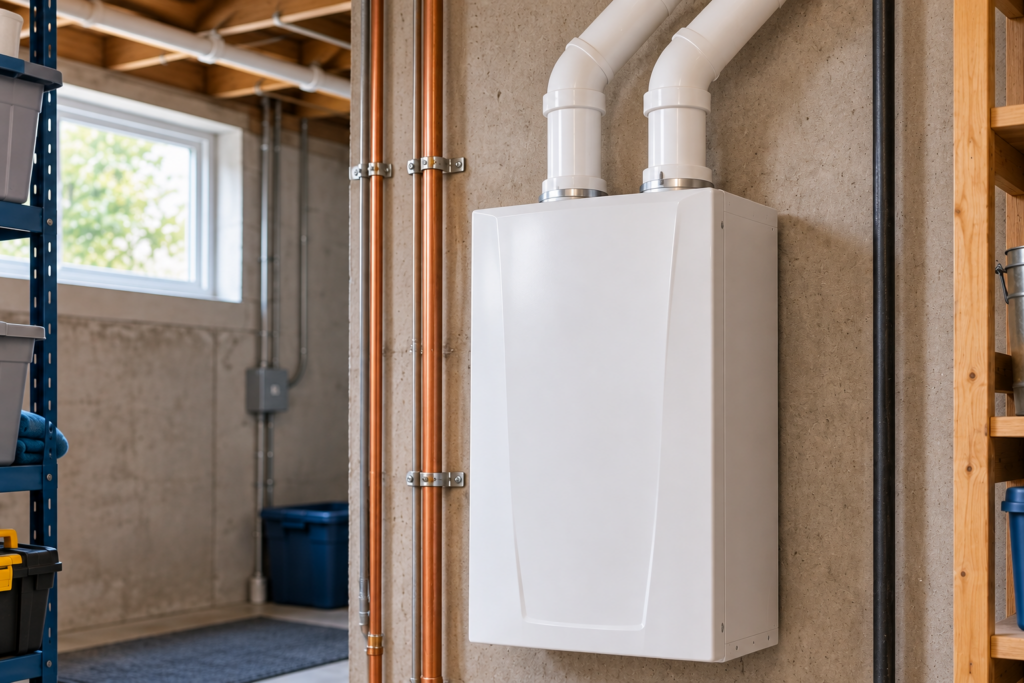
A conversion can involve more than removing a tank and mounting a smaller appliance. The existing fuel supply, electrical service, vent route, and water connections must be evaluated for the selected equipment. A quote should say which existing components can remain and which require changes.
- Fuel or electrical supply: What assessment has been made, and which modifications are included? A gas model and an electric model have different requirements.
- Venting and air supply: For combustion equipment, what route and termination are proposed? Ask whether wall or roof penetrations and their sealing are included.
- Condensate handling: If the selected model produces condensate, ask how it will be handled according to the equipment requirements and applicable installation rules.
- Water connections: Does the scope include the necessary piping changes, isolation and service access, and any other components identified during assessment?
- Location and access: Can the unit be installed and serviced in the proposed space? If it is moving, identify the additional routing and finishing work.
These are questions for the installer, rather than a shopping list of parts every home must receive. Ask for the property-specific requirements in writing. Avoid treating an allowance for an unresolved item as though the final work is already included.
Clarify removal, permits, and repairs to finished surfaces
Confirm whether the proposal includes disconnecting, removing, and disposing of the old heater. Ask who will determine the permit and inspection requirements, obtain any required approvals, pay the associated fees, and arrange inspection. Have that responsibility stated in the proposal without assuming that every installation follows the same process.
Conversion work may involve access through finished areas. Clarify whether the contractor will only close necessary openings or also complete drywall finishing, painting, exterior patching, or other restoration. A neat installation and a fully restored wall are separate deliverables unless the written scope includes both.
Also ask how long the water is expected to be unavailable, whether other trades must attend, and what could change the schedule. If a hidden condition is found, the proposal should explain how extra work will be documented and approved before it proceeds.
Compare conversion with replacing the existing type of heater
A tankless system can suit a household that values its space savings or a particular hot water usage pattern. It is not automatically the best replacement for every home. Extensive utility changes, a difficult vent route, or a straightforward need to replace an existing tank can affect the decision.
Ask for a practical comparison with an appropriately selected conventional replacement. HB’s water heater repair and replacement services include electric, natural gas, and propane equipment. Discuss the existing unit’s condition, installation work, household demand, and future maintenance rather than choosing solely by appliance size.
Be cautious about savings claims that lack assumptions. Actual energy use depends on the equipment, household habits, fuel costs, and operating conditions. A conversion proposal should stand on its documented scope and suitability, even when future utility savings are uncertain.
Request a handover and maintenance plan
Ask which installation and operating checks will be completed before handover, including checks required by the manufacturer and applicable rules. Have the installer explain the controls, where the shutoffs are, what documentation you will receive, and whom to contact if an error appears.
The maintenance plan should reflect the specific model, water quality, and usage. Confirm that future service access is available and ask whether any water treatment is recommended, why it is recommended, and whether it is included. Do not assume a generic maintenance interval applies to every unit.
Request the manufacturer’s written warranty terms and any separate installer labor coverage. Check registration requirements, exclusions, and maintenance obligations. The presence of a warranty is not a substitute for understanding what it covers.
Use the same checklist for each proposal
Before approving a conversion, compare the exact model and sizing assumptions, utility and venting changes, water connections, removal and disposal, permit responsibilities, surface restoration, exclusions, and handover. Ask each contractor to clarify missing items. A lower total may reflect a narrower scope; a higher total may include work another proposal leaves unresolved.
For help evaluating a tankless conversion in Randolph, Denville, or nearby communities, contact H.B. Service Plumbing & Heating LLC at (973) 934-2134. Discuss your current heater, the fixtures you use together, and the proposed installation location so the next step starts with the needs of your home.